Episode 11:02:55
Yorkshire Roots and Scottish Boots
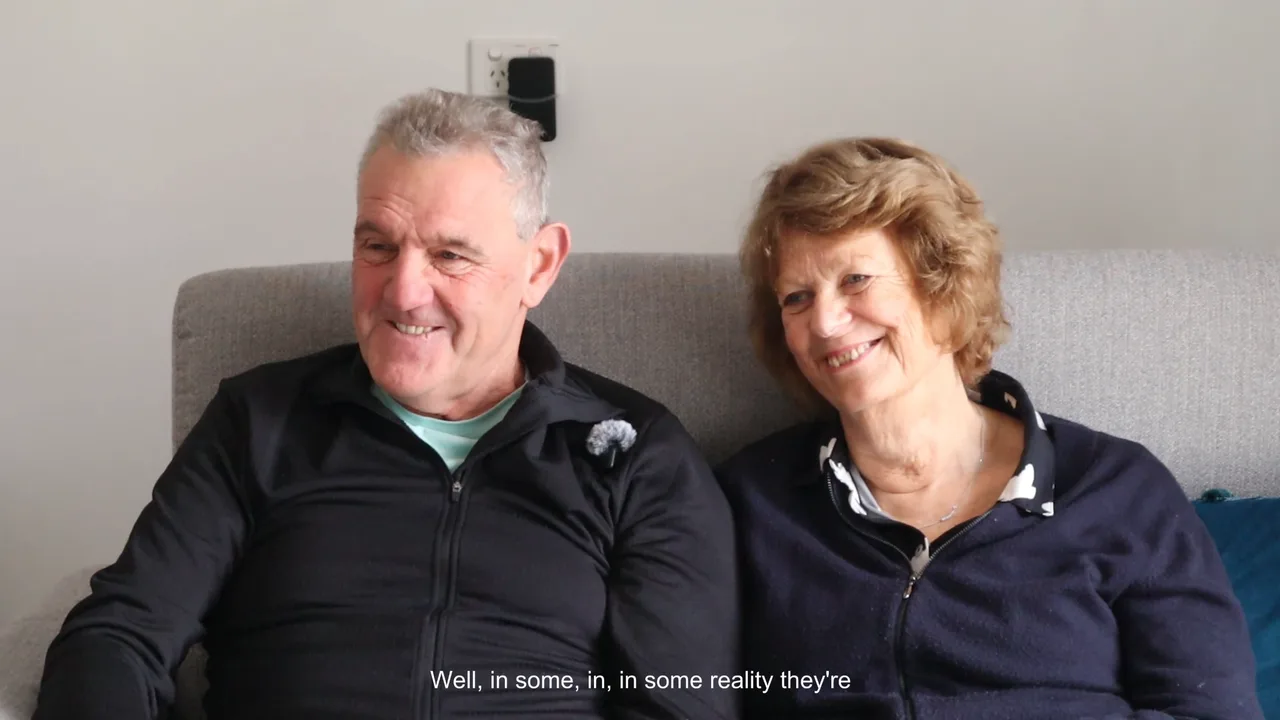
with Sue and Frank
Listen elsewhere
What do we carry with us when we leave one home and build another?
In Yorkshire Roots and Scottish Boots, Sue and Frank share their memories of migration, family and finding a place to belong - a place that now is home.
In this film, through personal reflections, they look back on the people, places and experiences that have shaped their lives.
About Sue and Frank
Susan Winn (Sue)
Sue moved from Yorkshire to Australia in 1978, where she built a life and raised her family as a single mother.
Frank McGrellis
Originally from Scotland, Frank arrived in Australia in 1987 to play professional football (soccer), after living in England and South Africa. He remains involved in football through coaching and youth development.
Their Melbourne Airbnb brought them into Merlin’s life when her family moved to Australia in 2016.
Reflections on this episode
Migration Can Be a Choice. Belonging Still Comes at a Cost
Sue and Frank’s journeys explore how belonging grows through friendship, everyday kindness and time.
Read the reflection →Transcript
Explore by chapter, or expand everything.
›00:00Welcome to Growing Roots
Hello friends, my name is Merlin. I moved to Australia about 10 years ago. Moving to a new country required me to rebuild my life and while doing so I realized that there are many others around me who have moved from different parts of the world for different reasons and trying to rebuild their life here. It's not easy. There is a lot of learning and a lot of challenges and each of those instances make up for some good stories. Stories that we rarely get to hear. At Growing Roots we want to have those conversations. We want to hear the stories that stay with people that never really get shared around. About the home they left behind, about the people they learned to love, about the jobs they found. We hope that it becomes a safe space where these stories are shared, celebrated and gives us, all of us listening, more context of the lives of people who live around us, with us, near us. Welcome to Growing Roots. My guest today has a very special place in our family's history. Back in 2016 when we decided to move to Australia it was a tough decision. We had never traveled to this part of the world. We had no family or friends living here. It was basically moving into the unknown. And I had more questions than answers. Where will we live? Which school would my son go to? You know, how would we find our jobs? Among all that confusion and questions, I knew I had to do one thing. Find a place to stay for the initial couple of weeks while we figure things out. And that took me to the Airbnb site. While scrolling through the listings, I found Sue and Frank. And I think what actually stuck with me while reading that listing was Sue's profile which said that she had moved to Australia in 1978. And that she knew what it meant to leave home and start again. Sitting 11,000 kilometers away in Bangalore, reading the sentence, I could feel the kindness and warmth right there behind those words. And the decision was made. We arrived here, we lived with Sue and Frank for almost four weeks. And they became our first family and friends in Australia. I remember when I was leaving the Airbnb and moving into our own rental place. I hugged Sue and cried. It felt like leaving home again. So when we finally decided to start Growing Roots, we knew there was no other person we wanted to talk and share their story first. Welcome to Growing Roots.
Thank you so much for having us.
So just starting, as I told you, Growing Roots is about, we want to share stories about people. Everybody has a history and story. And Australia being such a culturally diverse country, we have people from all over the world, and who have moved for different reasons, right. So there's a lot they leave behind. And then yet, they come and make a new home here. So I know that you moved here in 1978. Tell us about life before that, back in the UK.
›04:08Leaving Yorkshire for Australia
Yeah, well, probably quite different to your scenario. I was young, in retrospect, very young. I got married when I just turned 21 to Keith. And we were, I literally was just three weeks past my 21st birthday. And we jumped on a plane and we came to Australia. We didn't have the responsibilities that you had. We didn't have to worry about schooling. We really had no money either, which was probably a bit cracker. But we had enough money to buy a car. And that was it. We had none left. But we came for an adventure. We didn't know what it looked like. Look backwards to living in a small town in the UK, in Yorkshire. And back in the 70s, if you didn't leave home to go to university, you then would go to a different part of the country, you would have been living at home probably forever, you know. I don't mean in your parents' home. I mean in the same area. And that's not what we wanted. So we didn't go to university. So we came to Australia as an adventure. So it wasn't until the day I was leaving, I realised, oh, it's actually quite a big step you're making. And yeah, we jumped on a plane. And luckily, we had the support of the migrant hostel and the government assistance until you got on your feet in the 70s. There was a lot of, you know, assistance out there. So you weren't alone. And yeah, we just jumped on a plane and came.
So what was life like back then? Like, you know, before you moved here?
Before we moved. And family and dad. I have one sister. Again, you know, we didn't get married, you didn't move out of house, more or less, you know, we were a little bit more progressive than that, but not much. And yeah, I was working. Just what, you know, teenagers, etc. do, going out to the dancing and the pubs and the different things. Yeah, looking for something different, I think.
So do you remember the early days once you landed here?
Yeah, very much so. Because as I mentioned, the migrant hostel, we walked into the migrant hostel, we got off the plane and they put a little yellow dot on all of us that were going to go to the migrant hostel. And they took us on the bus to Maribyrnong, which is not actually that far from here. And we were given our little, we had a room and a bathroom and a bedroom. So it was like two rooms and a bathroom. And it was communal, communal eating.
First day, we're walking around like stunned rabbits. We didn't really know what we were doing or what we'd got ourselves into. And then we were walking along and then this Irish man came along whistling away and he says, you know, hello there. And then he took us into his little unit. He had a wife of four children. And that was our first friend who he's passed away, Robert, but his wife and his children are very much, you know, part of our, of my life anyway. And yeah, that was, that was our first meeting. But we also, at that time in the seventies, the migrant hostel, you might think was full of British people, but it wasn't. It was full of Vietnamese refugees and South American people who'd come over because of the dictatorships in Chile and Argentina, I think, etc. So it was a very much a minority of British people. And we were just, we just thought it was wonderful. We just, you know, our first impressions was just, wow, I came from the north of England. I hadn't met many people from anywhere else in the world. And we were just like, wow, this is fabulous, you know, from day one. And I've always enjoyed the multiculturalism in Australia. I think it's, you know, it's brilliant. Brilliant. So, yeah, so that was our first, our first experience was the migrant hostel. Once you sort of had your work and you got on your feet, the assistance was withdrawn, fair enough, you know. So we were there, I think we were there for about three months. And then we rented a flat, not that far away. And then my husband, he had a job to go to. He was a nurse.
So he started pretty quickly working. Again, look at, you know, I was just turned 21 and naive and shy and I had to find a job. And it was, it was hard. Like, where do I start? Where do I go? Whoops. And then I got a job. I saw it. I went for an interview at Myer at High Point Shopping Centre. And it was about, I'm going to say, a 10 minute walk from the migrant hostel. And I got halfway there and it started to pour down. So I didn't want to arrive dripping wet hair and looking ridiculous. So I'm like, I went into a mechanics workshop and I said, excuse me, shy girl here. Can you, can you give me a lift over to the shopping centre? I've got an interview. And he's like, oh yeah. Yeah. And he did.
Pretty brave of you to go and ask someone.
It was brave. Imagine turning up for an interview dripping wet, looking terrible. Anyway, I got a job as a secretary at Myer, High Point and which was great because I, again, I met some great people there and they made me very welcome and very at home. They took, they definitely took the Mickey out of me for my accent. It was thick Yorkshire accent and that was quite funny. But yeah, nice people. So how,
what do you think was different from the UK when you came here to Australia, you know, Australia of the seventies? I'm sure it was quite different.
Well, yes, it was very different back in the seventies. We've gone back a long way, haven't we? You know, time flies.
It does.
I mean, I suppose, obviously I had the advantage of having the English language, which made life a lot easier for me. And, but I was living in a city and that was a whole new ball game as well. You know, the town I came from, I think at the time, a population of about 35,000. So, but, but we just, I don't know what it was. I can't put my finger on it because some of the areas that we visited were probably quite dodgy here and there and everywhere, but we thought they were wonderful. I don't know. I don't think it was, I think it was just, you know, the opportunity to, when I keep saying get away from home, I had a lovely place, but I'd never seen, you know, the world, the world. And just going back to that, when we left, I mean, I knew Australia where it was on the map and things, but we really had no concept of what we were doing. You know, that's a long way. You talk about 11,000 kilometers. Well, we would have been more than double that, you know, and, I don't think it, the reality hit us until we were, we'd been on that plane and kept flying and flying until we got here. But yeah, so it was, it was an adventure. It was new. It was exciting. And we found Melbourne a great place to be. so I guess it was the size that was the, the thing. And, And
you mentioned, you know, people from different parts of the world. You had not
been, you know, in the workplace, you know, certainly of course in the migrant hostel, but everywhere we went,
yeah, we met some great people along the journey and, and, and yeah, brilliant.
At any time, did you ever think of going back? Like, you know, were there any moments like, you know, this, like you said, it was supposed to be an adventure. Yeah. Adventures don't last long. Did you ever feel like at some point, like this was,
I mean, the option to go back was always open because we had, you know, we didn't have commitments to anything and, you know, we hadn't sold a house to come here and we hadn't got children to worry about. So, you know, if we had ever wanted to go back, the door was open. It was no problem. It wasn't like this or that, one or the other. We had that luxury, I suppose. but did we ever feel like we wanted to go back? No. And, and back in the day, which I think would be very different to now is that we both worked, not in fancy jobs, but we had jobs and we bought that car. And we, I think we had about $400 left in the bank or something after we bought the car. And then, but British, well, Yorkshire people are known for being very careful with the money. So we lived off one wage and we saved one wage. And then after two years here, we spoke to somebody in a financial situation and said, what should we do? We're saving a lot of money. And he said, I thought he was going to say, buy a bar of gold or something, you know, I had no idea. And he said, you should buy a property. I'm like, oh, really? But that's the thing. In 1978, two years in, two people working two years in, you know, moderate jobs had saved enough money for a deposit on a house. And I'm telling you, we bought a house for $52,000 and our, we had a $30,000 deposit. So, you know, that was a good deposit. Two years. People couldn't do that now with the way things are.
Yeah.
So, you know, they called it the lucky country.
I was going to say, once we'd bought the house again, putting down roots, you get your house, you've got a different vibe, a different feeling. I think I felt more connected. And so, even though we always had the opportunity to go back, I don't think it ever really seriously crossed our minds, to be honest. Yeah.
And how was it like when, you know, kids came along? How did life change for you?
Life changes when you've kids.
It does.
Well, we were, I think we were four years, five years here before we had our first child. But again, bearing in mind that I was, I was still only, you know, 25 years old sort of thing. So I was still quite young, really. Yeah, look, life went in lots of different directions then. We, we went into our own business and we started to do things, differently. And, but yeah, what I, what happened to us is we, we're all, all the way over here. I think I mentioned I've got one sister, parents, very small family. Keith had a brother and a sister, parents, you know. Well, after I'd been here in Australia for, I'm going to say, four, five years, my sister decided she was going to emigrate as well. Her circumstances in Britain had changed. So her and her family came over. So, so then suddenly I had somebody here. And then after that, a few years after that, my mom and my dad retired from work. And they, well, we've got two daughters and grand, two grandchildren at that time in Australia. We're going to. And a similar thing happened on Keith's side as well. So we ended up with family here after, you know, five years that started to build. And so really there was no close family back in the UK anyway. But I'd have to say that for a hundred percent that we felt that our life here in Australia was a much better life than we would have had over there in terms of opportunities. Because I've always said in Australia, if you want to do something, if you've got an ambition to do something, you can make it happen here. And I never felt the same in the UK about that. Yeah. So, yeah, I think we were here to stay. Yeah. Yeah.
›16:36Frank's journey from Scotland
So how, how did you meet Frank?
Well, so my marriage lasted 15 odd years and, found myself as a single mom after that time. And, I've, I'd been single, not completely single.. I'd been single, for a while. And, I had a friend, he was an English guy. And I said, come on, Dean, you must know some nice decent bloke, my sort of age. He said, Oh, I do. I do. I know Frank. He's a lovely guy. He said, but if you think I love football more than life, more than anything, Frank's 10 times worse. And he is. But that was 18 years ago. He's still here.
Are there any traditions that you have carried forward? Like, you know, something that you used to do back, back in the UK, Yorkshire?
Not, not so many, actually. they, the sort of one that sticks out to me is Christmas. and my daughters are all born here. sort of more or less insist on, you know, hot roast turkey lunch, you know? And I'm like, do we need hot? And they're like, yes. And that's weird because it comes from them. They drive that, not, not particularly me. But no, there's, there's not a lot that we've kept traditional over the years, to be honest, outside of that. I mean, probably different for you coming from, you know, different sort of background. What traditions have you kept up, I think?
Well, for, to start, I love wearing a saree. I've started, I've tried to keep it there, you know? So I, I do something called Saree Thursdays. So I try and wear a saree to work, if possible. and I think food, it has stayed, like we, I do cook a lot of Indian food, at home as well. It's just comfort food and, you know, what we are used to. So you tend to go back to that automatically. And, and yeah, and you know, you mentioned Christmas, but I think, I thought it was a little weird to celebrate Christmas in the summer.
Yeah. Yeah.
Like, you know, I mean, you've always been like winter, you're going for the midnight mass and things like that. And suddenly here, you know, in bright daylight, you know, and, and it's peak summer. So, you know, it's like you have daylight till 10, 10 PM almost here. So it's a kind of little weird to, celebrate Christmas. I think that was a bit of a shocker when we came here and we're still getting used to it.
I know, we're still getting used to it. My birthday's in July. So my birthday's always in the British summer. Now, middle of winter.
And same here. It was always during school vacations back in India. And now, you know, it's in the, yeah, middle of winter. So you might just wake up to a gloomy day.
That's right. You mentioned earlier about the foods and things like that. And I thought I'd make something today. Just like if we had coffee or something like that. And my first thought went to scones, jam and cream, very English. But my second thought immediately after that was lemon slice. Right. So another person that we met very, very early on in the place, Keith worked with, Andrew and his, wife was Bev. And Bev and her family live in Bendigo. And within three weeks of knowing Andrew and Bev briefly, they were going off to the UK on holiday. They left their car with us for us to use until we bought a car. And then they went and visited my mum and dad in the UK while they were over there. And when they came back, they invited us to Bendigo to where Bev's mum and family were. And lemon slice was on the table when we got there and with coffee and whatever. And those visits to Bendigo that went on for many years, where her family embraced us, like here we were, two random migrants. And immediately that kindness of a car, you know, I'll meet your mum and dad, come up and spend the weekend, come up for Easter, come up, you know, where did that come from? You know what I mean? And that makes you feel very much, you know, at home and a part of a, you know, being a part of it, you know, very kind. And the experience of going to a home in Bendigo where it was still very country, traditional, old -fashioned, old-fashioned, you know, like, was amazing.
So, yeah.
And I remember you always used to say, you know, pay the kindness forward. Because I, I, I remember there were instances like when we had moved and I, you know, obviously we didn't know anybody. And, you took me out for these coffee walks and, you know, introduced me to your friends. And, and I was always grateful for that generosity and, you know, the love you showed to this person you just knew for a week or so. And, I remember asking you, how do I ever repay, you know, this? And you have, your go-to sentence was always, pay it forward, Merlin. So, yeah, thank you. Yes, you always say. I guess your experiences, right? Like this, so somebody showed kindness and instead of just stopping it with yourself, you, you know, let it be passed on to others.
That's right. Yeah.
So, so yeah, that's beautiful. Yeah. how, how did you come about starting the Airbnb? Because that also leads to you meeting a lot of different people, I believe.
Yeah, definitely. well, I have this area at the back of the house, which was just sitting there really. So it's a separate bedroom, bathroom and a tiny living and kitchen area. And, I've traveled a lot myself and, traveled on the cheap wherever I can. And, I've traveled in Europe and used Airbnb quite a lot. Even, you know, where you actually go into somebody's house and you just take their bedroom, you know, anything like that. And it's, I think it's a great, I like that side of the Airbnb of just accommodating people on a budget. And, but the, the benefit of all of that too, is that you sort of see how people live, which you don't see if you're in a hotel or an apartment, you know, fancy apartment or anything like that. So I thought I'd give it a go. I didn't really expect, you know, I would get a lot of people really, I'd imagine people coming to Melbourne and they want to stay in the city and things, but no, not necessarily. They don't actually don't want to stay in the city. And it's been, it's been lovely for the last year, 10 years, I've been doing it. And, I should have looked the numbers up, but you know, it's more than 500 guests in that time. And, from all parts of the world at the moment, there's a Chinese lady out there with her son, and they speak no English whatsoever. but you know, I said to them to wave as they come back, because I've got, they're here with a, a relative that lives close by. And through him, I can say, you know, tell them what's going on, you know, so if you do see a couple of people waving at you. But yeah, I get people from all around the world, you know, lots of people from within Australia, but actually all around the world. And, yeah, I love it. I love it. And, you know, I do it. I mean, don't get me wrong. I don't mind the income. I'm not knocking it, but I haven't put my prices up in, a long time. Once, I've maybe once in 10 years. I don't, I do it because I enjoy it more so. And, I've met some, some brilliant people through it and it gives me my traveling money too. So it's good, but it's a win -win situation. Yeah,
100%.
I often think, when will I stop it? And I think, well, not yet. Yeah.
Well, I'm sure there are a lot of people out there who might be needing it in some time in the future.
And I have a lot of regulars, a lot of people who come here several times a year, they might have family in the area and they come to visit their family, but there's, you know, room to, no room to stay there or whatever. So, you know, some people, you know, three, four, five times a year, even make friends from all over the place. Yeah.
That's amazing. Do you get any, like when people leave, do they reach out to you later on? Like,
yeah, yeah, I do. I do get, follow up of, like, yeah, I had a young German, German couple here with a little baby. And then I introduced them to a friend of mine who, whose son also had a baby the same age. And now they're planning on across the, the globe trips, you know, to Germany, to Australia. Oh, amazing. Australia to Germany. So yeah, little friendship formed outside.
Oh, that's amazing.
It is.
Yeah. It'll be 50 years, you know, almost like, you know, in a year or two, since you arrived here and, we talk about growing roots, right? So, was there a moment in time when, you felt that, yes, like, you know, there's no going back. I believe you mentioned that, you know, probably buying the house was one of the instances. Was there any other, like, you felt like, okay, now this is, this is my land. This is where I belong.
I think, I think very early on, I think I got that, I got the idea this is where I wanted to be. And so very few thoughts about going back. I think I mentioned that earlier. I do believe that at the time, Australia offered a much better life than the one I would have had in the UK. I, I think the only thing that would have pulled me back would have been family, but that was, that, that pressure was taken away when they came here. I've still got, two cousins over there and school friends that I'm keeping in touch with quite a lot. And I'm able to get back and see them. And that, I'm able to get their back quite regularly, really, and, and see them and catch up with everything. So that's enough for me. I don't think there was ever really a question that this is where my future was. And so, yes, like you said, three, three daughters and now six grandchildren, aged between sort of, three and eight. when you look at the photographs of like, you know, two people that came over
young and, you know, lost, lost, whatever. And then now it's like, whoosh, you know, and of course they're all Australian, they're all born here. So they are, you know, we do talk about, British life. And of course, they knew my mum, my daughters knew my mum and dad and my granddaughters, their children didn't know, know them, but, lots of, they're very interested in that side of the life, but of course their lives, this is it, this is Australia. and this is where their, where their home is and where they were born. But, yeah, over 50 years. Yeah.
›28:34Finding a first home in Melbourne
Does it feel like it's been a lifetime or does it feel like it was just yesterday that you did?
It's very clear. My life, you know, before and my life after. And when you ask me about the immigration and our life, it's very clear. but you know, I guess it's just getting older anyway. You look back and 50 years is a long time. But no, all good. All good.
Any, any, special memories that you go back to, like, you know, 50 years is a long time, I know, but any milestone memories you think about, you know, difficult times or good times that, that come to mind?
yeah, I think we've all got difficult times in our lives, you know, that, that, that come and go. And, but I've always felt that I've always felt Australia is a very positive place. And if you really, you know, wanted to do something or achieve something or get somewhere, or, you know, it could be done. In Britain, sometimes you felt that you were a bit curtailed by, you know, what school you went to, or, you know, you know, there's more of a class system. There used to be, you know, class system and things like that. But Australia, to me, was like, an opportunity to do what you wanted to do. Like, I went back to university when I was 39. And, you know, that was an easy thing to do. Whereas in Britain, would it have been easy to go back as a mature student? I'm not really sure if it would have been. you set your mind to something. I've always thought the opportunities were here. Like in Britain, it's sometimes you're putting a little back, oh, you know, what did your dad do for a living? And, you know, what, what was that situation like? Because she would follow along that track or, whereas here you can follow your own track in anything you want to do. I, I fail. And yeah. Yeah.
Yeah. And I agree with you because, you know, after moving here, I think that's one pressure that goes off. Like back in India as well, you know, success is often associated with, you know, the job you do and, you know, how much you earn. And I think it's true in many places around the world. But, I do feel in Australia, you know, you can be anybody. You're, you're not measured by your title or, you know, how much you earn. everybody is equal. Like you, you believe that and, and that's how everybody acts with you also, you know, it's not like nobody comes and asks, Oh, you know, are you from the, you know, at this, do you earn this much? Or do you, you know, is this, this your title? So I'm going to behave differently with you kind of thing. Right. Yeah. I think that's definitely so. And it, and I think, you know, as a parent, it's very important because, I think all of us just want our kids to be happy, you know, doing whatever that makes them happy. Yeah. And, sometimes because success is so defined in places, it becomes hard to, you know, not every kid would want that maybe whatever, you know, their passions they want to follow. And, but because success is, you know, you have to be this so-and-so or you have to be, you have to earn, you know, X amount of money that just adds unnecessary pressure.
So I did feel a lot of relief when I moved here. I felt like, you know, I mean, I just wanted my son to be happy. It didn't matter whatever he wanted to do. And yeah.
And that's right. And people don't, aren't judgmental about anything like that.
Hundred percent. And, and everybody has a, like, you know, they live life. Like I feel like, you know, everybody has that work, work-life balance is true in Australia. You know, I mean, you work, you also, you know, you travel, you go out and it's not limited to just people, you know, having highly paid jobs or anything. I feel like everybody, you know, takes life seriously and, you know, they, they do things that make them happy, they travel and it's just amazing. Like, I don't think we would have had that mindset back in India.
So, yeah, that, that's very, yeah, it is very similar actually. So yeah, a bit
of that classist and, you know, structure of an influence, like, you
know, depending on your status, you can have influence as well.
So going back to the migrant hostel, one of the, we met a Danish couple and I never met Danish people before, but we became very friendly in that short space of time before they left. That was only like, I don't know, seven or eight days and they moved to the eastern side of Melbourne and we kept in touch. And I, I remember thinking, well, they were seven years older than us, which seemed like a lot of the time because, you know, and they were mature and worldly and actually she was a journalist, but she struggled a lot because she didn't have English as a, as a, as a first language. Anyway, but, but Peter was a dentist and I'm liking, oh my goodness, we're from a very working class background and we're friends with the dentist and like, they're like, you know, who cares? But that was me, you know what I mean? But that wouldn't have happened in, in England, I don't think, you know what I mean? And that, that hit me at the time, like, why would they want to be friends with us? But we're still friends now. Yeah. And very good friends.
Yes. Yes. I think, yeah. And do you think it is because of the multiculturalism and, you know, people have probably experienced those things back home and not liked it. So when they come here, it's easy, right? Nobody knows it. So it's easy to just give up on those, you know, unwanted.
Yeah. Yeah. Yeah. And, and I've never felt, yeah, I've met people from all around the world and that's what I've always loved about it here, that we're all equal. That's the end of it.
Do you ever think what would have happened to you? Like, what would life had been if you hadn't moved to Australia when you did?
It would have been, it would have been sort of, what's the word, set? Is that the word? It would have been going along a particular path, which may or may not have been okay. But I think being here has brought so many opportunities and, you know, excitement and a much better place for me. You know, no disrespect for what I've left because I've still got all the respect for everybody back there and things like that. But for me, I think I needed that adventure and I think it has been an adventure and it's been a very positive adventure despite, as I said, a few, you know, not so great times in my life. But, yeah, it's a place that you can just come back out the other side and get on with it. And, yeah, I think Australia's been very kind to me.
What is the one thing that you're really proud of?
Proud of.
I think just probably that journey that I've had, making the best of it. Obviously, you know, I'm very happy that I've got three healthy, happy daughters and six grandchildren. And it's like, wow, you know, when you look at a picture of, I think I said that earlier, just the two of us starting out and now it's a bit of a crew.
Now you have your own family tree.
Yeah, that's exactly right. Yeah, we've got our own family tree. And it's, you know, that's the journey that you probably have wherever you live. But putting it back onto Australia is the place that I've been. Obviously, I'm very lucky that I've had that journey.
So I wanted to ask you, you know, obviously, back in the 70s, communication was not as easy and simple as it is now. So how did you keep in touch with your family once you moved here?
Yeah, well, that was that was hard because no, no sort of mobile phones, no FaceTime calls or whatever, you know, and aerograms, you know, short letters or full letters in an envelope. If you wanted to talk to your family, we had to book a telephone call through the post office. And we would have it would be timed. And I don't remember the dollars, but it was very expensive. And so, you know, you might talk for five minutes or six minutes or something. But like, you know, hey, mom, I've got a job. I wanted to tell my mom I've got a job, you know, so I had to ring her and had to go through this whole process. But it was funny little things that like you take for granted now, like you'll just message someone, Zoom them, whatever. But like, I had this big problem, I'm like, mom, how do you hang your socks on a line? Do you hang them from the toe or from the heel? And like, as if it would matter, you know, but things like that, I was so naive. I had no idea. I'd come from a home where my mom did everything pretty well. I couldn't really, I couldn't cook. Once I invited some of the guys that Keith was working with over for dinner and I made chili con carne, but I got teaspoons and tablespoons mixed up. It was inedible.
But, you know, I'd love me to ask for these, about these things. They couldn't pick up the phone. That was embarrassing.
I can imagine.
But yeah, yeah, you do take, now that the communication we have today,
unbelievable, you know, but back then it was, it was, you know, you send a letter, you know, maybe three weeks later you got the reply.
Yeah.
And yeah, to sit down and write something was, yeah.
And you mentioned that your parents eventually moved here, right? Like, so maybe in mid 80s they moved. That's right. And obviously they moved later in life. Yeah. So how was it for them adjusting here? Like, you know, you were young and when you're young, I believe you're way more flexible, like, you know, getting, living in a place, adjusting. But how was it for your parents?
Yeah, it worked out really, really well for them. So I think I mentioned earlier, my dad was retiring and he retired at 57 years old. And he said like, right, you know, two daughters and I think at that time, two grandchildren in Australia, we want to, we want to come over. And he was probably the one that drove it and not so much my mum. But they came over and chose a house near my sister. And because Keith and I sort of seemed to be on the move a fair bit. So they just wanted, you know, they got some great neighbours. They joined some clubs, you know, gardening club and they stayed near the club. My dad was always wanting to do a bit of artwork. So he sort of got into an art club. Absolutely loved it. Never looked back. And my mum also, my dad died after 10 years here. And my mum, well, she was nearly 90 when she passed away. So she had a good chunk of time on and on. I think she, you know, she'd already established a great group of friends and everything like that. So funnily enough, I think that they actually settled so well at that, at that age, left behind 57 years in their hometown where they were born, married, grew up, walked away from that at 57. Yeah. Yeah. Quite a big thing to do, but yet settled in brilliantly. And my mum would be keen to go back and visit her sister. And my dad would be like, you know what, I'm fine. I'll just stay here.
›40:31The people and places we carry
Which kind of speaks a lot about Australia itself. Looking back and I wonder like, we moved here, you know, like I was in my 30s when I moved here. And I wonder, you know, would life had been easier? At least when, you know, the start, in the initial years, when we were trying to rebuild our life here, you know, it felt like, you know, would it have been easier if I had moved earlier? You know, I mean, because as you get older, it's harder to make new friends and, you know, find your own kind of people, like that's what you think. But I think 10 years down the line, I feel like, I guess there was, you know, it was a good time we came, we had a good life back in India, you know, we still have friends we go back to. And we have managed to make new ones here. So no regrets.
I guess that's, that's the beauty of Australia.
Yeah, it's funny how we're here and we're, we happily go back, you back and go back to India and I go back, you know, but there's a lot of people in Britain wouldn't attempt to come on this journey because it's like, oh, it's too far, it's too long. But we happily go back. Yeah, yeah.
Yeah. I mean, we just, because you do miss your life back. Like for us, I know, for you, it was, you know, I mean, you're pretty young and this was, you're just starting out. We had a pretty settled life back in India and we had a amazing set of friends. So, and family is still there. So you do feel like, I know when people ask me, you know, where are you going for vacation this year? I said, India, like, you know, if you get a chance, you know, a couple of weeks, if you can get away, definitely it will be to, you know, visit my family and be with my friends. And, yeah. Well,
you know, it's a small world, that's what they say. So I've got the best of all worlds, haven't we?
100%. 100%. And I want also, I remember when we had lived here, like, you know, I mean, and I left a review for you on your Airbnb, five stars. But I also, you know, in my review, I'd mentioned that how we feel about a place, you know, like when we move countries or places, how we feel about a place depends on the first few people we meet, and the impression they leave on us, right. And we love Melbourne, we ended up loving Melbourne. And you and Frank definitely had a significant role doing that, like, you know, for making us feel at home. Did you ever feel at that point that you were making this kind of a difference for us?
Like, I enjoy, you know, sharing what we've got, or sharing my experiences or sharing anything to make, you know, life a bit nicer for somebody. So yeah, I actually get pleasure out of that as well. So it was a two-way situation.
Welcome to Growing Roots, Frank.
Thank you.
How come you missed your football today?
I got the notion that Merl and Rony were coming, and just doing a little bit of filming. And then Sue gave me your preparation. And I went, wow, now I realise why you want to be here for four hours.
Okay. So, Frank, looking, when did you arrive in Australia?
Yeah, I arrived here in 1987. Came a round about way, born in Scotland. When I left school at 16, went to England for eight years, left England and went to South Africa for five years, and came here to Australia, arrived here in 1987.
And how has it been? Like, you know, it's been 40 odd years, 30? Oh, nearly 40 years.
Long time
looking back. But Scotland, England, Britain, it was pretty tough times when I left. I was only young in employment. But the government was cracking down on Unions in Britain, and it was a good time to leave. And I arrived in Johannesburg and off the plane. And the team manager said to me that, don't expect too much from South Africa at the moment. It's in the middle of a recession. And I thought, uh-oh, it was a good time in my life, the five years there.
But with the insecurity in South Africa, the apartheid and the Dutch government and the other African background people. Yeah, it was testing times, and it was time to leave. So, Australia was a good place to come to.
And how has it been here? Like, what is the thing that you like about Australia? You've been here long enough, obviously.
Yeah, look, look, I came here for my sport, which is football, soccer. And it's, it's grown big time. Australia just represented in the World Cup, as you probably know. Yeah. And, but I came here as a player and then sort of moved into coaching. But, the changes in not only the sport, but, in the, the Australia itself. Melbourne, Melbourne was the place to be.
Tell us something about how you met Sue.
Yeah, Sue, I knew for a year before I met her. Oh. Because my friend, Dean had asked if I would come and meet Sue. yeah. And, for some reason, my commitments and Sue's commitments, we didn't quite meet until, we eventually got together. And, yeah, we've never really been apart since.
So tell us about the first date. How did that go?
Yeah, well, as it happens, it was a Friday night and I was training as usual and then I made it to meet in Glen Waverley, which is a suburb in Melbourne. And, I think it was about half past eight, nine o'clock by the time we eventually met. But, yeah, after the meal, we kept on having drinks afterwards. And, yeah,
we got to know each other.
We actually were, we had dinner there and then the restaurant was closing. And so there was four of us having
dinner and the guy in the restaurant said, well, there's, somebody's 30th birthday party upstairs,
you should go, he won't mind. So we said, do you mind? Come on. So we ended up at somebody, random person's 30th birthday.
That was our first date, yeah. Into the early hours.
So, you both run the Airbnb together. How, how, what do you, like, and I was asking Sue about this as well. You know, she does get a lot of people from around the world. How is that as an experience?
I hear Sue saying she loves what she's doing and she loves meeting people and helping people. And, I would say 99% of the B&B, Sue does. But, in the times that I'm around or she's not available, yeah, quite happy to help. And it's been, yeah, 10 years nearly. And, the amount of different people, you've experienced it, the amount of different people that come and go and, give her a good review. I think she does very well with her preparation. And I think she does very well with her delivery. and that's why it's, yeah, it's very seldom vacant.
We've got similar sense of the humour, which is fortunate, you know. We would have, if I'd been with somebody from
different parts of the world, we'd probably been divorced 20 years. I think, is that fair to say we've got the same?
No, I think you're right. We're pretty relaxed around each other. And, yeah, we sort of, we make it happen. We make it work. it's, I realised it was as long as it is, it's just flowed since the first time we met. It's just flowed and sort of here we are. some of the happy events, grandchildren of Sue's, weddings of Sue's children, my own kids coming and visiting. Yeah, we're pretty relaxed around each other.
It's amazing. Considering England and Scotland. Yeah.
Well, in some, in, in some reality they're friends and living together.
So that's fine. That's it. So far, so good. Yeah, indeed. Watch this film.
[50:40]Merlin: Frank, you know, we were really amazed to know that there is a Wikipedia page in your name. So, do you want to tell us how that happened?
well, I can tell you that I didn't put on Wikipedia because I wouldn't know how to do it. So, I got knowledge of that through other people who were sort of searching the net for me and, checking me out. So how it came about, I don't know, but, there's some information that I've got a twin that, I'm around football matches so much that they thought there was two of us. So that's, yeah, that's not quite true.
Does that mean if you get an opportunity to go and play in Europe now, you're going to go and live in Europe?
›51:27What home means now
I think my playing days are over. I keep saying that I've scored my last goal.
Do you remember when that was? Like, they say you never know when it's your last goal. How about
you? it would be here in Melbourne, but no, not quite sure.
Okay.
Now I've got to research. Great job. You're creating work for me.
And, and which team did you play for?
Yeah, I came here and played for a team called Brunswick Juventus, who were in the NSL at the time, and then moved to Morwell and then moved to Springville City for five years. So I finished my playing career at Springville City here in Melbourne.
And how long ago was that?
Yeah, that was 91, 1991. Yeah. So I've been coaching since then. I've done some senior coaching with some of the football clubs around Melbourne. And now I focus on some of the elite kids and what we call our NPL system here in Melbourne.
You mentioned, Merl, about, you know, showing you some things that I, you know, brought with me. I didn't bring a lot of stuff with me, but I can never let these go. And I don't even really know particularly the history of them. So this, I don't know, it's just an old coin that my dad had 1951 Festival of Britain. No idea really. But, you know, just old bits and pieces. This book here is postcards that my grandmother would have written to her mother. Oh. And so there's all sorts of nice little, you know, scripts behind them, little stories. And then, and then, and, and, and the stamps.
Oh, amazing.
I do wonder whether there was any money as well. But, you know, you know, yeah.
So it's quite, yeah. So who made this? Your mum made this?
My grandmother. Oh. My grandmother. Yeah. Oh, wow. It's like part of history that I don't know. But what do you do with it?
I don't know what happened to it in the end. But anyway, but it's lovely. So I don't know if it's like special for, for a reason
that is weird, but yeah, lots of.
So this was another thing that you got from UK when you came here?
Yeah.
Oh, wow. I'm sure that it had some sentimental value. I mean, like.
It does, but you know, like what happens to things that you keep from all people, but do your kids want them? What they do, sit in a box for another 50 years?
Well, we live in the age of AI and at some point we would need things that we can feel and, you know, touch and get a feel of. So, yeah, absolutely.
For some reason, like, here's my British passport that I came over on in 1978. You know, why have I kept it? No idea. But yeah, I have kept it.
But that's a piece of your history, right?
Yeah.
I mean. What about my driver's license? How's that?
That's from the UK? Or here?
No, it's my English driver's license. Oh, wow.
Do you drive when you're back there?
Yeah, but. This doesn't work?
It was issued in 1978. Oh, okay. I asked somebody when I was
over there and they said, well, yeah, it expires in 2027.
27? Oh, wow. Okay.
Issued in 1978. Anyway, a couple of weird things. So then that has a reason to exist right now. Anyway. You can drive on your Australian
passport in England and in Europe. So anyway. Okay. That's.
But there's just, you know, and I've just gathered a few photographs over the journey as well. Yeah, sure,
sure.
What you've got there is, is, is, that's, that's one there of my, Family. My family, my mum and dad is all in Australia. Then when they were here, my sister and myself and their six grandchildren. So my sister's got three children too. Uh-huh. So that, we all ended up here in the end, you know? Yeah. Yeah. Yeah. So, yeah, that one there. Amazing. And then there's my six grandchildren there. Yeah. With a Koala. Down at Apollo Bay.
That's so cute. Yeah.
Yeah. This one here, we talk about history and things like this. This is one of, my granddaughter, Lily, she has, she's at school and she had an assignment to do at school and had to pick something old, a relic out of the, out of the, you know, do with family. And so she had to interview me and she chose to, to follow my dad's little, time he served in the, in the army. And, that, that's quite nice to see parts of my history coming back out to the school kids. And it's, if I didn't have all of these bits and pieces with me, that's my dad's tie from his army days. Oh. Oh. His dress, his dress uniform, the Gordon Highlanders. Well, you know, I've kept that. And you brought that with you? Oh, okay. She's still got it actually. Amazing. So yeah. Okay. But yeah, so, and their photographs are always.
These are your daughters?
Yeah. Well, you know, I've got big mix of, I've got a mix here of me at school, back in the olden days. And my daughters there. I've got pictures of the, people I met in the migrant hostel.
Oh, wow.
That were friends, you know, they were, this is the whistling Irishman. And then his family and different family as well.
Yeah.
But the trouble with photographs, these guys, they're all either, I've got photographs, hard copy.
One of my grandmother's, that was her house. I've been back on holiday, I've snapped them.
But these are just different houses I've lived in, over the years. That was the, that was the house we bought for $52,000 in 1981. It's now worth about $2 $2 million.
Wow. That's the first time you grew root.
I wish I'd kept it.
yeah.That was then the first time you grew roots,
That's it, yeah. Yeah. That's one that, my mom and dad's house in the UK before they left. Okay. Yeah. So just bits and pieces of over the years. And, people I've met and kids growing up. That's it. Yeah.
Thanks Merl, that's been a very interesting few hours. I've enjoyed it. what, what's made you go along this track? I mean, I know you said I'm the first one that you're interviewing and whatever, but where, where, where do you see this Growing Roots heading? Are you going to, what's, what's your story behind that?
Growing Roots, it came about because, you know, I have a friend at work and, Kristina and me, we keep talking to each other and we realised she's a, she comes from a Macedonian background and, you know, I'm come from an Indian background, but, through our conversations, we discovered how similar our cultures are. And, and it just, struck us that, you know, there's so many different people, in this country, like, you know, Australia is home to, I think, you know, people from maybe 150 countries living here. Ah, from there. And, and many of them have come under different circumstances, you know, some might be refugees, some for better opportunities, some for other reasons. And, everybody has a journey and there is a story, you know, there's a place they left behind that they used to call home. And, and then, you know, starting from scratch, you know, how much we struggled in our initial days, you know, we didn't know, would we find the next job, would we find a house. So, so yes, I think it was just the curiosity of, you know, learning from others, like listening, you know, what happened, how did they find their roots here? I mean, when did they start feeling that this had become home? And, yeah, so Growing Roots came from there. I mean, as the name implies, you know, when did you start
growing roots?
Yeah. I feel once you grow roots, you are set forever there, so. There'd be so, so many stories when you think about it.
So interesting.
It is. And everything is different. Like, so like, you know, I mean, you and me, we are first generation. And in case of my friend, Kristina, she's a third, third generation, immigrant, like, you know, she, grandmom, grandparents were immigrants. So, yeah, it's, it's just, I also feel that, you know, I mean, all of us are connected by the kindness, like the kindness you showed me. I'm sure somebody else is also doing the same to other people. And maybe, you know, it's about taking that kindness forward. These stories might inspire another person. And next time you're with someone and, you know, I mean, you might just see them as people who had a past, you know, I mean, I, I always feel like when I'm talking to new people here, I have to give so much of context, about my life because obviously, you know, they've just met me and then, so, yeah, that context, if you can, if you have that context, I feel you'll see people differently and act differently around them. So is this, Growing Roots, we hope will become, a place to have those conversations and, you know, keep those stories alive.
I think it's going to be so interesting.
Thank you for trusting us with your story, Sue. And, it just goes on to prove that, you know, every family's story, their history starts with a journey somewhere, a place they left behind probably, and one person, you know, taking the decision to be brave. So, yeah, thank you so much for speaking with us.
Ah, pleasure. Enjoyed it.
Thank you. 10 years ago, when we arrived in Australia, we were looking for a place to stay. What we found was something much more meaningful. We found kindness and we found friendship. And today we had the privilege of speaking to the woman who gave us both. Thank you for joining this conversation at Growing Roots. We look forward to keep bringing you stories of leaving, belonging, and becoming. Thank you.